There is no single “best” format
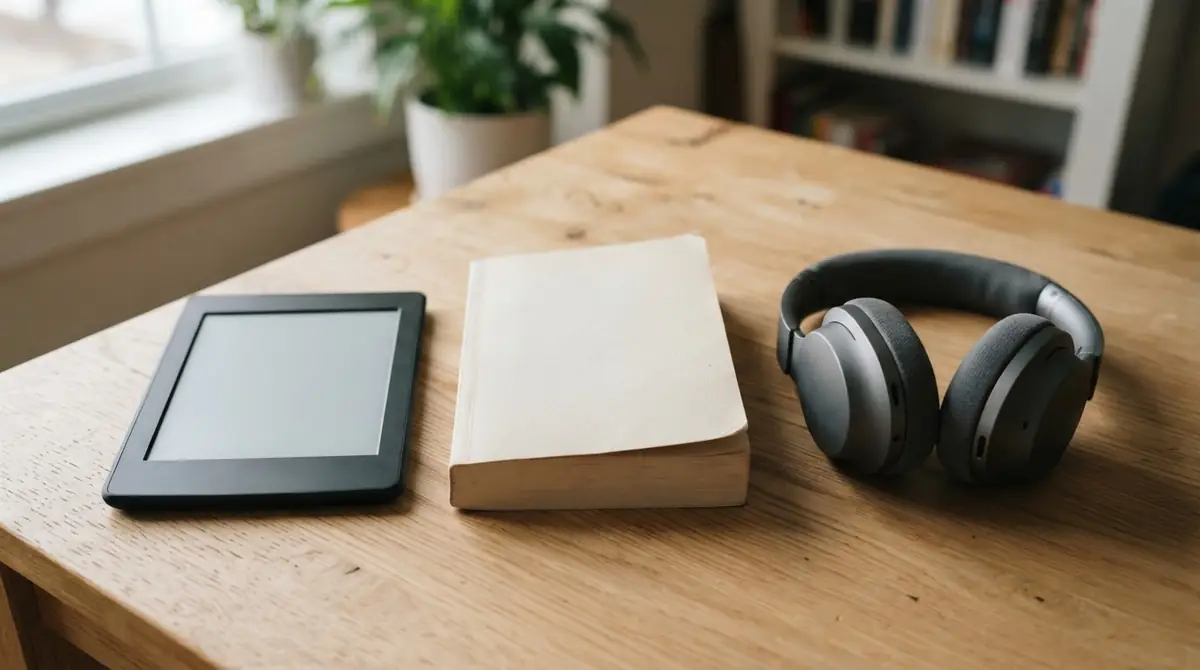
Readers often argue about which format is superior. In reality, each format suits different goals and situations. Many keen readers use all three. This guide compares them honestly so you can choose wisely.
Quick comparison
| Factor | Ebook | Audiobook | |
|---|---|---|---|
| Comprehension of complex texts | Strong | Good | Good for narrative, weaker for dense material |
| Portability | Low | High | High |
| Cost | Varies, used copies are cheap | Often cheaper, frequent deals | Can be expensive; subscriptions and libraries help |
| Eye strain | Low | Low on e-ink, higher on phones | None |
| Note-taking | Easy by hand | Easy highlighting, searchable | Harder |
| Multitasking | No | No | Yes |
| Accessibility | Limited font size | Adjustable text size | Helpful for visual impairments and dyslexia |
Print books
Advantages
- Better for deep reading. Several studies suggest readers understand and remember long or complex texts slightly better on paper than on screens, possibly because of the physical sense of place in the book.
- Fewer distractions. No notifications or apps.
- Easy to annotate. Margins and sticky notes make active reading natural.
- Enjoyable to own and share. Many readers love building a personal library.
Disadvantages
- Heavy and bulky to carry
- Takes up space at home
- New hardcovers can be expensive
Best for: studying, classics, dense nonfiction and books you want to keep.
Ebooks
Advantages
- Portable. Thousands of books on one device.
- Adjustable text. Change font size and spacing, which helps many readers.
- Instant access and frequent price deals.
- Built-in dictionary and searchable highlights.
- E-ink readers are designed to reduce glare and are comfortable for long sessions.
Disadvantages
- Phone and tablet reading can bring distractions
- Licences often limit sharing and reselling
- Some people remember less detail when reading on screens
Best for: travel, commuting, fast-paced fiction and readers who need larger text.
Audiobooks
Advantages
- Multitasking. Listen while commuting, cooking or exercising.
- Great narrators can bring stories to life, especially memoirs read by their authors.
- Accessibility for readers with visual impairments, dyslexia or eye fatigue.
- Easier entry to difficult books. Older language can be easier to follow when performed.
Disadvantages
- Easy to lose focus and miss sections
- Harder to reread or take notes
- Less suitable for books with charts, tables or complex arguments
Best for: memoirs, narrative nonfiction, novels and busy schedules.
Does listening “count” as reading?
For enjoyment and general understanding, research suggests comprehension of stories is broadly similar whether you read or listen. For studying or complex material, reading print often has an advantage because you can slow down, reread and annotate. So yes, listening counts. Just choose the format that matches the purpose.
Choosing by goal
- I want to study or learn deeply: print, with notes.
- I want to read more books overall: combine all three. Our guide on reading more books shows how.
- I travel a lot: ebook reader.
- I have a long commute: audiobooks.
- I’m on a tight budget: library apps and used books. See building a home library on a budget.
Tips for each format
- Print: keep a pencil and small sticky notes inside the cover.
- Ebook: turn on airplane mode or use a dedicated e-reader to avoid distractions.
- Audiobook: start at normal speed; increase speed gradually if you want, but slow down for complex sections.
What readers actually choose (2025 data)
The format debate is louder online than it is in real life. Pew Research Center’s October 2025 survey of more than 8,000 US adults found:
| Format | Read or listened in the past 12 months |
|---|---|
| Print book | 64% |
| Ebook | 31% |
| Audiobook | 26% |
Print is still comfortably ahead, but both digital formats have roughly doubled since 2011. Age makes a big difference: 41% of 18 to 29-year-olds read an ebook in the past year, compared with 23% of people over 65. For audiobooks the gap is wider still, 32% against 13%.
Money follows the same pattern. The Association of American Publishers reported that in 2025, trade hardback revenue grew 3.9%, ebooks 3.0% and downloaded audio 5.3%. Every format grew, and audio grew fastest. In other words, readers aren’t switching formats. They’re adding them.
You’ll find more detail in our reading statistics and audiobook statistics guides.
Final thoughts
The best format is the one that gets you reading. Use print when you want depth, ebooks when you want convenience and audiobooks when your hands and eyes are busy. Together, they make it easy to fit books into any day.
Frequently asked questions
Is reading on paper better than reading on screens?
For long or complex texts, studies often find a small comprehension advantage for paper. For lighter reading, the difference is usually small.
Are e-readers better for your eyes than phones?
E-ink screens reflect light like paper and don't emit bright backlight in the same way, so many people find them more comfortable for long reading sessions than phones or tablets.
Is it cheating to listen to audiobooks?
No. Audiobooks are a legitimate way to enjoy and learn from books, especially for narrative works. For dense study material, print may be more effective.