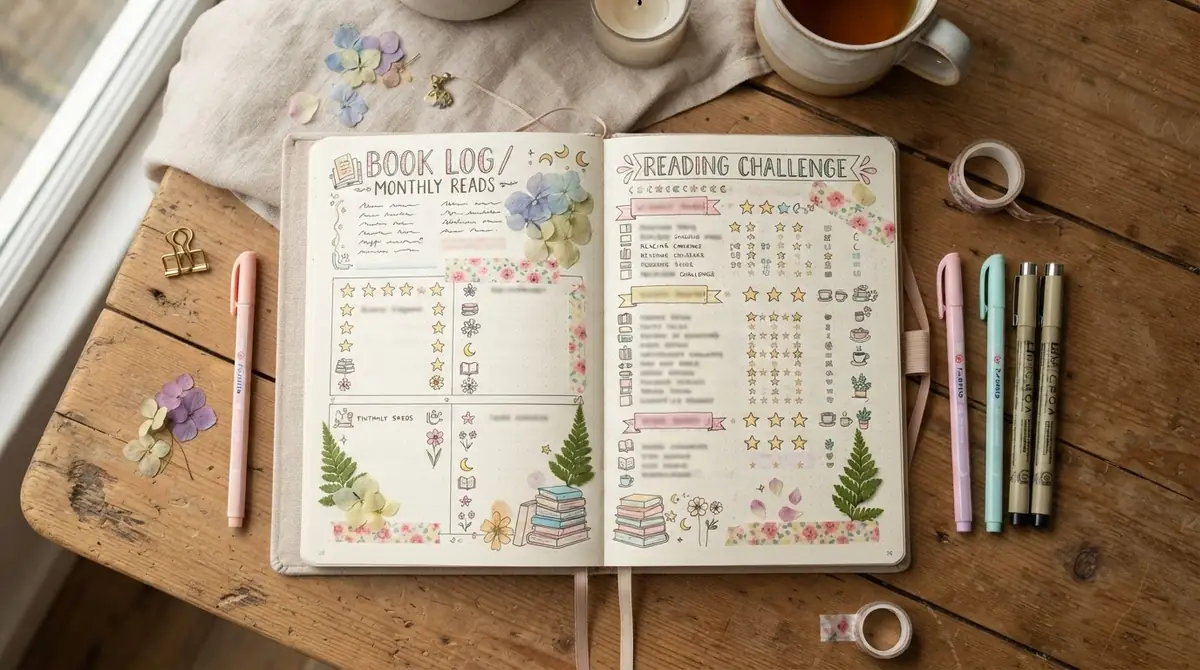
Why keep a book journal?
Most readers forget the details of a book within weeks. A book journal helps you:
- Remember more of what you read, because writing about something strengthens memory
- Notice patterns in what you enjoy, so you choose better books
- Track progress and stay motivated
- Collect ideas you can return to later
It does not need to be beautiful or time-consuming. A simple notebook and five minutes after each book are enough.
What you need
- A notebook (dotted, lined or blank) or a notes app
- A pen you enjoy using
- Optional: coloured pens, sticky tabs or printed book covers
Digital journals work well too. A spreadsheet or notes app is searchable and always with you.
Essential pages to set up
1. Reading log
A running list of every book you finish. Include:
| Title | Author | Date finished | Format | Rating |
|---|---|---|---|---|
2. To-be-read (TBR) list
Write down books you want to read and where you heard about them. This stops you forgetting good recommendations.
3. Book review pages
One page per book with your thoughts. See the template below.
4. Yearly goals
Write simple goals: number of books, genres to try, classics to tackle. Keep them flexible.
5. Favourite quotes
Collect short lines that move you, always noting the book and page.
A simple one-page review template
- Title and author
- Dates started and finished
- Rating out of five
- One-sentence summary in your own words
- What I liked
- What I didn’t like
- Favourite character or idea
- Would I recommend it? To whom?
For deeper reviews, our guide on how to write a book review explains each section.
20 reflection prompts
Use a few of these whenever you finish a book:
- What was the book really about, beyond the plot?
- Which character did I understand most, and why?
- Did the ending satisfy me?
- What question did the book leave me with?
- Which scene will I remember in a year?
- Did the book change my mind about anything?
- What would I ask the author?
- How did the setting affect the story?
- Was there a moment I nearly stopped reading?
- Which book does this remind me of?
- What did I learn that I can use?
- How did I feel while reading?
- Was the title a good fit?
- Who in my life would love this book?
- What would I change if I were the editor?
- Which idea do I disagree with?
- What surprised me most?
- How did the book’s structure work?
- Would I reread it?
- In three words, how would I describe it?
Fun extra pages (optional)
- Genre tracker: colour in a box for each genre you read.
- Monthly wrap-up: books finished, best book, least favourite.
- Series tracker: list series and which book you are on.
- Reading challenge page: for example, “a book from another country” or “a classic”.
- Books to buy versus borrow: useful if you are building a home library.
Tips to keep going
- Keep it simple. Elaborate layouts look nice but can make journaling feel like a chore.
- Write immediately after finishing a book while your thoughts are fresh.
- Allow short entries. Three lines is better than nothing.
- Review your journal at the end of each year. It’s a satisfying way to see your reading life.
A sample entry, filled in
Templates are easier to use once you’ve seen one completed. Here’s a short entry for a classic most readers can finish in an afternoon:
The Old Man and the Sea, Ernest Hemingway Started 3 March · Finished 4 March · Print · Rating 4/5
In one sentence: An old fisherman’s long, lonely fight with a giant marlin becomes a story about dignity in defeat.
What I liked: The plain language. It’s so simple it feels like a fable. Santiago talking to the fish made me unexpectedly sad.
What I didn’t: The middle drags a little, though I think that’s deliberate.
One idea to keep: You can lose the prize and still not be beaten.
Who I’d give it to: Dad, who likes the sea and short books.
That’s about five minutes of writing. A year of entries like this becomes a record of what you read and who you were while reading it.
Final thoughts
A book journal turns reading from something you consume into something you keep. Start with a reading log and one short review page. You can always add more as the habit grows.
Frequently asked questions
What should I write in a book journal?
Start with a reading log, a to-be-read list and a short reflection after each book: a summary, what you liked and disliked, and a rating.
Is a digital or paper reading journal better?
Both work. Paper can feel more personal and memorable, while digital journals are searchable and easy to carry. Choose the one you will use consistently.
How long should a book journal entry be?
As short or long as you like. Even three sentences after each book help you remember more.